RSS icon

Combustible Dust & Static Electricity Q&A

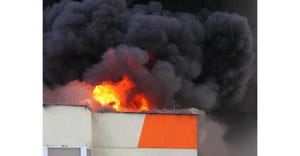
  •   Are there any specific filtration and/or maintenance concerns for dust collectors handling combustible metal dusts that may be tinged with pickling compound? The facility in question blasts fabricated carbon steel parts (the carbon steel is pickled to prevent corrosion) with steel shot or grit. The dust collection system for this operation is a pulse-jet dust collector using fire retardant pleated cartridge filters, with a spark arrestor located at the inlet to the unit. Despite regular “routine” maintenance and approximately annual cartridge changes, the dust collector has caught fire about once every 2-3 years. Is more frequent maintenance/cartridge changeout necessary? Or should a custom cartridge designed for both oil resistance and flame retardance be considered for this application?

    Occasional fires in iron dust can be attributed to a low rate of heat transfer [resulting from iron-particle oxidation] to the external environment, resulting from occasional thick layers of dust and prolonged infiltration of air into the “center” of the accumulated dust. To prevent fires in iron dust, one may consider avoiding the formation of thick accumulations of dust by frequent [or continuous] removal of dust from trays, hoppers, or drums, or discharge iron dust into an “excess” of water [since "moist" iron dust could generate hydrogen gas].

  •   When using a standard bag discharge system (bag dump station) with integral filter unit, what safety precautions should be taken while unloading powder into the hopper?

    Generally speaking the measures that may be considered in order to reduce the risk of a flash fire/explosion during the charging of powders from bags into a dump station include:
    • Ensure that all the metal sections of the bag dump station are electrically bonded together and grounded
    • If the Minimum Ignition Energy of the dust cloud is less than 30 mJ, ensure that the operator(s) are grounded (resistance to ground less than 100 M ohm)
    • Ensure that the dust exhaust system is preventing the spread of the dust cloud into the room
    • Avoid vigorous dumping of powder from bags into the dump station
    • Prevent the accumulation of any dust outside of the bag dump station by implementing an effective housekeeping procedure
    • Seek expert advice (consider conducting an onsite dust explosion hazard assessment to identify and control all potential ignition sources and make provisions to protect people and the plant against the consequences of a flash fire or explosion)

  •   I would appreciate an opinion regarding the Electrical Area Classification for the Area involved in the following Solid Handling System. 1. Granulated material of wood chips with plenty of dust. Ambient to high temperatures and 40 to 100 psig inside silos. 2. The above material transported via screw conveyors. 3. Electrical motors than can be exposed to the granulated material in case of upset conditions. 4. Grounding system that could fail during upset condition.

    There is not enough information provided in order for us to provide specific replies to the above questions. However, the following general comments are made to help push the discussion forward:
    1. “Granulated material of wood chips with plenty of dust, ambient or high temperatures and 40 to 100 psig inside silos”
    Space inside silos should be classified as Class II, Division 1, Group D hazardous location. If silos are located indoors, depending on: (a) amount of dust being released from silos to surrounding area during normal and abnormal operating conditions, and (b) housekeeping practices, the area around silos’ dust release points should be also classified as Class II, Division 1 (or 2), Group D hazardous location using NFPA 499 guidelines.
    2. “The above material transported via screw conveyors”
    Space inside screw conveyor enclosures should be classified as Class II, Division 1, Group D hazardous location. If the conveyors are located indoors, depending on: (a) amount of dust being released from conveyors to surrounding area during normal and abnormal operating conditions, and (b) housekeeping practices, area around conveyors dust release point should be also classified as Class II, Division 1 (or 2), Group D hazardous location using NFPA 499 guidelines.
    3. “Electrical Motors that can be exposed to the granulated material in case of upset condition”
    If granulated material contains sufficient amount of fine dust it would be prudent to classify area as Class II, Division 1 or Division 2 (depending on presence of combustible cloud and/or combustible dust layers) hazardous location and motor should be rated and installed according to NEC requirements for such an area.
    However, if granulated material does not contain fine particles less than 420 micron in combustible concentration and hazardous area classification is not required per NEC, there is still the possibility of a fire hazard. Upset conditions involving granulated materials quite often involve significant spills that can partially or completely cover the motor. This could create a condition that: (a) affects dissipation of heat associated with the motor thermal loses. This may lead to the motor overheating resulting in motor fire, and/or exothermic decomposition (spontaneous combustion) of granulated material; and (b) material can penetrate the motor enclosure and jam the rotor.
    Motors that are subject to such upset conditions should be: (a) equipped with an internal high temperature sensor having contact connected with the motor control circuit in such a manner that the motor is stopped when internal temperature exceeds the temperature rating of the motor internal insulation; and (b) should have effective ingress protection to prevent the powder entering the motor enclosure (motor should be at least TEFC or TENV type).
    4. “Grounding system that could fail during upset condition”
    Grounding system should be designed with redundancy that ensures equipment grounding even during “the worst case scenario” upset conditions.
    As I mentioned above, these comments are based on the information that was provided and is therefore not intended to provide specific answers.

  •   I have an application where we blast new carbon steel parts in a large wheel blast machine using steel shot. The steel is slightly “pickled” but not oily. The dust collection system is approximately 100 ft away and has several elbows. The dust collector sees moderate loading (55 gallon drum a day) of fine metal powder. The old dust collector caught fire twice and the replacement went two years and then caught fire for unknown reasons. The unit is grounded and I don’t think static charge is an issue. Can there be an exothermic reaction with steel dust/air/moisture?

    It is likely that an exothermic reaction was the ignition source for the fuel in the dust collector. Of the two types of fuel – steel dust, and oil – it is more likely that the oil was the fuel and also [indirectly] the ignition source. It is well-known that “partial oxidation” of hydrocarbons is exothermic – leading to an increase in temperature – and can lead to the formation of aldehydes which have low auto-ignition temperatures. For acetaldehyde, the AIT is 175 °C, and a thick layer of oily dust can prevent escape of the heat that results from the “partial oxidation”. To prevent recurrence of fire, you may consider either: (1) discharge the accumulated dust into water, or (2) minimize accumulation of oily dust by frequent removal from the dust collector and deposit the dust in water prior to storage, transport, and/or disposal.

  •   Is carbon black an explosive risk? I will be transporting from a bag dump to a storage hopper using a screw conveyor. I have suppliers that state it is a risk and I have read industry papers that say it is not an explosive risk. Can you provide some assistance regarding the explosive risks of handling carbon black in a powder form?

    The following factors should be considered while handling carbon black dust:
    In my experience, fine carbon black dust is an explosible/combustible material. If you are unsure whether the grade of carbon black dust that you are handling/processing is explosive or not, consider conducting an explosibility screening test (Go/No Go test) on a representative sample of the carbon black.
    If the dust is found to be explosive, minimize the spread of the dust cloud by the provision of an effective local exhaust ventilation, prevent the accumulation of dust on the outside surface of the equipment and in the room by adapting an effective housekeeping procedures, and control potential ignition sources.
    Ways to control potential ignition sources include: ensuring that all metal sections of the bag dump station are bonded together and grounded; conducting a hazardous area classification to ensure the use of appropriate electrical equipment; preventing foreign objects from entering the screw conveyor; maintaining the mechanical (moving) parts of the system to prevent their failure. Additionally, if the Minimum Ignition Energy (MIE) of the dust cloud is less than about 30mJ, the operator(s) handling the dust must be grounded. Also, protect processing equipment such as receiving vessel(s) and dust collector(s) against the consequences of an explosion by the provision of appropriate protection systems (e.g. explosion relief vents).
    Also, seek expert advice on identification, assessment, and control of potential dust cloud explosion hazards.

  •   I need to clean out a paper dust filter (bag house) and have contracted a vacuum truck to do the job for me. Their standard practice is to bond and ground the truck. The plastic hose will have a copper wire duct taped every 5 ft or so to limit static buildup in the hose. Is this sufficient? Will introducing a water spray at the suction inlet reduce the potential for static buildup? Will it reduce the explosive nature of the dust?

    The following factors should be considered while conducting the cleaning of combustible paper dust:
    Wrapping the outside surfaces of the standard plastic hose (generally a highly insulting material) with a copper wire would not prevent the buildup of electrostatic charges on the inside surfaces of the hose. Indeed, very energetic electrostatic discharges could result that are capable of igniting most combustible dust cloud atmospheres.
    The use of water spray may prevent the accumulation of electrostatic charges on the inside surfaces of the hose if all the surfaces are adequately wetted and the wet surfaces are in contact with electrical ground at all times. An adequate water spray may also render the paper dust particles non-combustible. However, one may end up with electrostatically charged isolated wet surfaces (patches) that could produce energetic sparks if the water spray is inadequate or intermittent.
    I suggest that you consider using an electrically grounded conductive or static dissipative hose or performing a dust explosion hazard assessment on the operation with the objective of identifying, assessing, and controlling dust cloud explosion hazards throughout the operation.

  •   We have a design for a 6 in. PVC drain pipe planned to go through a coal silo that contains lots of dust inside. Do we have to be concerned about electrostatic charges? If so, how can we eliminate the problem?

    The question lacks some details about the design. Our response below assumes that the PVC pipe is going through the coal silo carrying drain water.
    The PVC pipe may be used for this application provided that all of the following conditions are met:
    • The only material that goes through the PVC pipe is water,
    • The water flow through the PVC pipe is slow and does not result in the formation of droplets within the pipe,
    • The mechanical integrity of the pipe is maintained and no water can leak into the coal silo,
    • There are no electrically isolated conductive (metal) objects such as metal brackets or flange coupling on the outside of the PVC pipe, and
    • There is no flammable vapor/gas atmosphere present in the coal silo at any time.
    Generally speaking, it is suggested that an electrically grounded conductive pipe is considered instead of the proposed PVC pipe. Alternatively, consider routing the pipe from the outside of the silo.

  •   Can you recommend a safe practice for the addition of powdered or granular materials (non-combustible) into a mixing vessel containing a flammable solvent?

    Generally speaking, the following measures should be considered during the manual addition of powders to a vessel containing a flammable liquid:
    • Use an all-enclosed system for adding a powder to a vessel containing a flammable liquid. If this is not possible/practical, then the following measures may be taken to reduce the possibility of an electrostatically-initiated flash fire during manual addition of powder to the vessel:
    • Grounding of the operator(s) with a resistance to ground less than 1×10⁸ ohm.
    • Using a grounded conductive (metal or fiberboard) container and/or scoop.
    • If the powder is in a plastic liner, the liner should have a surface resistivity less than 1011 ohm per square (static dissipative) and grounded during pouring of powder.
    • Use a grounded conductive chute with a self closing flap to reduce the amount of vapor that might escape through the manway.
    • Use an effective local exhaust ventilation very close to the manway opening to reduce the spread of the flammable vapor atmosphere into the room.
    • Depending on the conductivity and chargeability characteristics of the liquid, there may be a need for inerting the vessel at all times including during the manual loading of the vessel.

  •   Is there equipment available to reduce expanded polystyrene at 1 per cu ft density to .45 mm particles or smaller in volumes of 200 per hour?

    Please see our response to your question (If we understand your question correctly): Powder materials have a tendency to generate and accumulate electrostatic charges during processing and handling involving various operations (including but not limited to) milling, grinding, sifting, pouring etc. Electrostatic charges generated on the materials can greatly affect the bulk density of the materials. Generally, the effect on bulk density is greatly seen on the highly insulating powder materials (such as polyethylene, or polystyrene materials), where the similar (either positive-positive or negative-negative) electrostatic charges generated on particles repel each other and reduce the bulk density of the material. Conversely, powder mixtures with components that are charged with opposite polarity (positive-negative), tends to stick together creating particle agglomeration and hence increasing the bulk density.
    The polarity (positive or negative) and quantity of the electrostatic charges generated on the powder material as a result of an operation are extremely important data. Electrostatic characteristics tests (such as Volume Resistivity, Charge Relaxation time and Chargeability) of the powder materials can identify both the quantity and polarity of electrostatic charges on a material as well as the ability of the material to retain those charges. These tests results are then evaluated to select effective methods to control the electrostatic charging of the powder material during a specific operation and hence controlling the bulk density. The common methods for eliminating/controlling electrostatic charge on powders include the moisture in the air or the powder, passive or active electrostatic charge neutralizers, and process controls (flow speed, material of processing equipment).

  •   Can you suggest a valve bag filler for an explosive material, such as icing sugar?

    There are various designs and types of valve bag fillers available in the market depending on the nature of the product, speed of the operations, production rate etc. The selection of one of the designs for your operation would primarily be based on the specific material safety information and the most practical method of ensuring safety. Additional factors to be considered during the selection of valve bag fillers are:
    1) material of construction such as plastic or metal etc.
    2) electrical components such as electrical motors, electrical panels, switches, electrical weigh scales etc.
    3) components that can cause frictional or impact heating.
    Icing sugar (fine powdered sugar) could be very sensitive to ignition and could therefore be readily ignited by certain electrostatic and mechanical ignition sources. It is suggested therefore that in order to select the right type of valve bag filler, appropriate information regarding the “ease of ignition” and the “severity of the explosion” of your specific dust be obtained. In general, depending on the dust cloud properties, one may need to consider an all-grounded metal valve bag filler. Operators coming into contact with the dust cloud must be grounded (by use of antistatic shoes and flooring). All mechanical moving parts must be maintained and effective means for safely controlling the spread of dust clouds must be deployed.